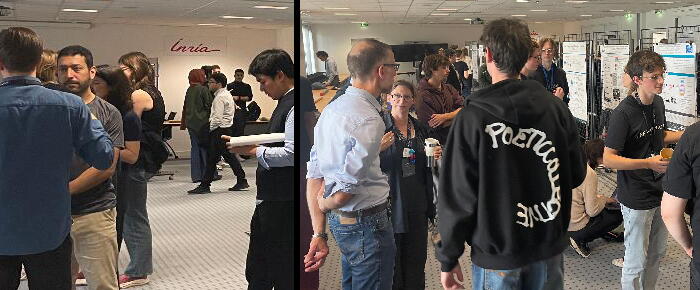
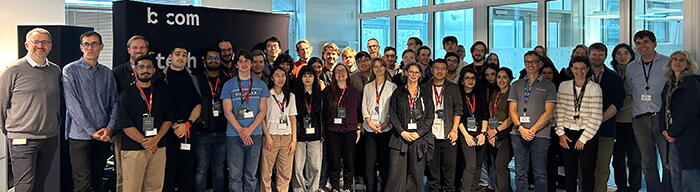
On 8 and 9 October, IRISA welcomed 40 PhD students from the Swedish WASP programme (Wallenberg AI, Autonomous Systems and Software Programme).
As well as showcasing our laboratory, this visit reflects a shared commitment to fostering mobility and partnerships between Sweden and IRISA.
WASP: a programme of excellence supporting Swedish research
The Wallenberg AI, Autonomous Systems and Software Programme (WASP) is a Swedish national programme for research, training and the recruitment of scientists.
Primarily funded by the private Knut and Alice Wallenberg Foundation, with contributions from partner universities and industry, its aim is to position Sweden amongst the leading countries in the fields of artificial intelligence, autonomous systems and software engineering.
The programme supports research projects, trains PhD students within the Graduate School, assists with the recruitment of researchers and fosters links between academic research and industry. It encourages exchanges with foreign universities in order to strengthen international scientific networks and create new opportunities for cooperation.
On the programme: an insight into our research in AI and robotics, tours of experimental facilities and scientific discussions to foster future collaborations
This year, the WASP programme chose France as the destination for its tour of research centres and laboratories. After a three-day visit to Paris, they travelled to Brittany to visit IRISA. The programme included a presentation of our work in artificial intelligence, robotics and software engineering, a tour of two of our experimental platforms, as well as discussions with our scientists and two key players in our ecosystem: B<>com and Orange.
Our experimental platforms
ROBSTAR
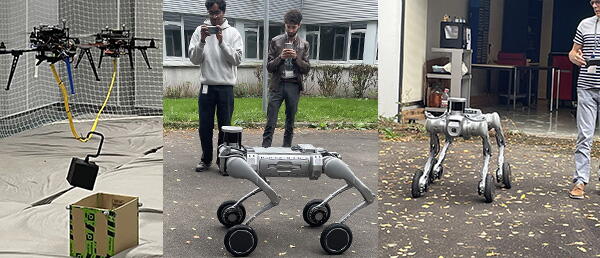
The visit to ROBSTAR provided an opportunity to showcase the work of the RAINBOW research team through a number of experimental set-ups.
- At the robotic manipulation exhibition stand, visitors were able to view various pieces of equipment, including Franka manipulator robots and the TRIAGo mobile robot. The latter consists of a mobile base, a motorised torso and three manipulator arms that can be fitted with hands, robotic grippers or cameras.
- The tour continued on the aerial robotics platform, with a presentation of the flight cages and the various types of drones that can operate there. This included a demonstration of visual guidance, in which two drones connected by a cable coordinate their movements to pick up an object and place it in a designated spot.
These experiments demonstrate the diversity of research being carried out in robotics, whether it involves manipulation, the control of aerial robots or cooperation between several autonomous systems.
IMMERSIA
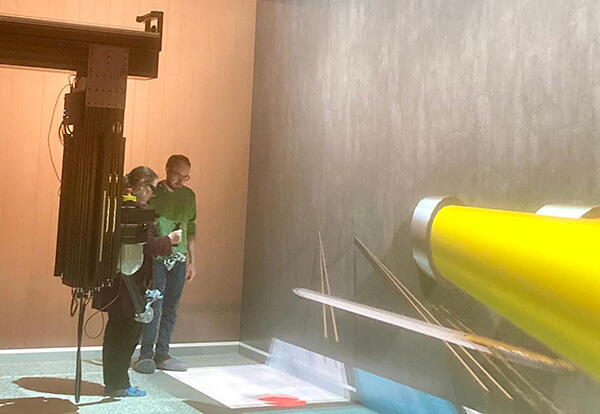
At the IMMERSIA platform, PhD students were able to experience different forms of virtual immersion and learn about the research into perception and interaction in digital environments being carried out by our VIRTUS, SEAMLESS and RAINBOW research teams.
- The first consisted of a scene recreating a realistic outdoor forest environment, which gave an insight into the visual immersion that Immersia can offer.
- A second demonstration focused on physical interactions in a virtual environment, using haptic arms and virtual objects that allow users to feel contact, sensations of weight and various tactile interactions.
- The delegation also discovered a piece of equipment recently acquired by the laboratory: an omnidirectional treadmill used in conjunction with a virtual reality headset. This technology enables the user to move around part of the city of Rennes by walking on the treadmill.
Artificial intelligence and robotics: discussions on complementary research
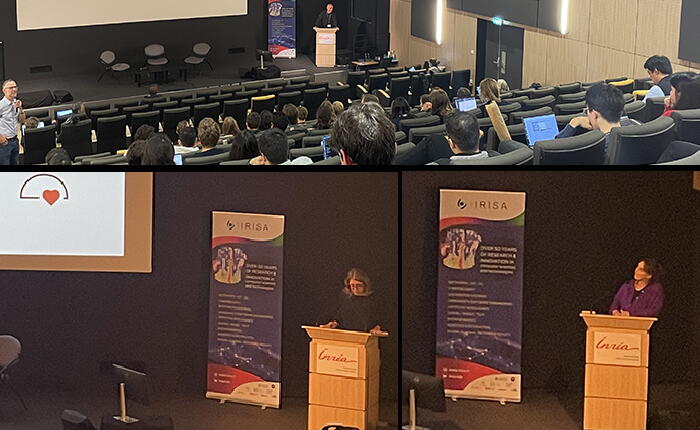
Elisa Fromont, a lecturer at the University of Rennes and head of the MALT research team, presented the team’s work, which focuses on machine learning and the challenges associated with analysing complex and evolving data.
Three main areas of focus were highlighted:
- Machine learning models for temporal data (sequences, time series, videos), addressing issues relating to representations, the generation of such data and early predictions. The presentation focused on an application for the early detection of whether or not in vitro-reared bovine embryos are transferable.
- The adaptation of machine learning models to changes in data and class distributions over time, with an emphasis on domain adaptation, continuous learning and sequential learning. The presentation briefly highlighted continuous learning of foundational models for time-series prediction.
- The reliability of time-series models, with a focus on explainability, privacy, fairness, robustness, efficiency and generalisation of these models.
Following on from the tour of the Robstar platform, Paolo Robuffo Giordano, head of the RAINBOW team, presented his team’s research in several areas of robotics: notably active shape control of deformable objects and the design of new mechanisms and the design and control of aerial manipulators – flying robots equipped with on-board arms. The team is also interested in shared control architectures for manipulator robots and multi-robot teams, as well as assistive robotics.
Finally, Lisa Hanselmann presented the Cluster SequoIA, one of France’s nine centres of excellence in artificial intelligence. It is dedicated to security and trust in and through digital systems, with two main areas of application: cybersecurity and defence, as well as Earth observation. Deeply rooted in France’s national AI strategy and closely linked to industry, the cluster aims to conduct high-impact research whilst contributing to the European AI strategy through its involvement in the French ‘AI Factories’ initiative. It offers numerous opportunities to forge partnerships and collaborate on applied AI research, including, for early-career researchers, a postdoctoral programme with 18 months’ funding, launched annually at the start of the calendar year.
Other highlights of the event included a poster session designed to encourage discussion amongst early-career researchers and a visit to b<>com, attended by representatives from Orange
A particularly well-received part of the event was the poster session, which brought together PhD students from IRISA and the WASP programme. These discussions enabled the young researchers to present their work, exchange views on shared scientific challenges, and foster the establishment of initial contacts and the identification of potential synergies between our various institutions
The visit concluded at the b<>com premises, in the presence of Orange, with a presentation of their research and development activities and their innovation ecosystems.
A shared ambition: to develop international partnerships
Hosting this delegation demonstrates our commitment to strengthening our ties with leading international scientific communities. As well as showcasing our laboratory and our research ecosystem, this meeting provides an opportunity to forge links between our young researchers, to encourage mobility and, we hope, to spark future joint research projects.