In Rennes, Lannion and Vannes, our scientists came together to introduce schoolchildren and the general public to computer science research through interactive demonstrations, talks and immersive experiences. Here’s a look back at some of the initiatives that marked this year’s event.
In Rennes
Computer science research in the service of mobility
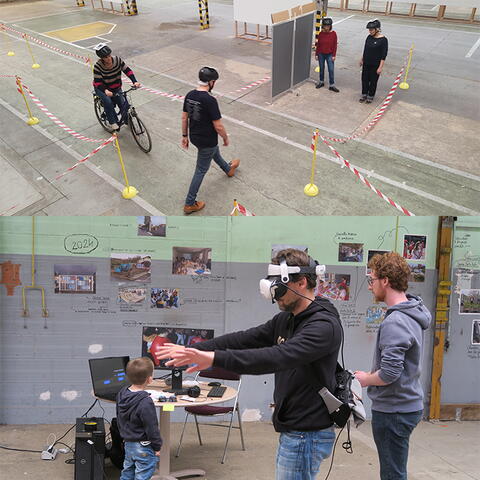
At Les Halles en Commun in La Courrouze, the VIRTUS and RAINBOW teams showcased their virtual reality research on the theme of mobility.
Through a range of immersive experiences, visitors were able to observe and experience the interactions between users of public spaces (pedestrians, cyclists, motorists and wheelchair users) in order to gain a better understanding of the challenges of coexistence and safety in shared spaces.
The teams put on four demonstrations:
- PERCEPT-PIÉTON : a virtual reality simulation that allows users to experience what it is like for a pedestrian to walk behind a car or between two vehicles, with the aim of raising awareness of road safety
- VROOM – One Man Crowd in Rennes : une immersion virtuelle dans le centre-ville de Rennes, où la foule se densifie progressivement autour du participant.
- Simulateur de conduite de fauteuil roulant électrique : une expérience d’un usager en fauteuil roulant électrique de déplaçant dans une avenue du centre-ville de Rennes.
- IPiC : une mise en situation réelle des interactions entre piétons et cyclistes, destinée à capturer leurs mouvements pour tenter de les reproduire dans un environnement virtuel.
Partners in these research projects: Université Rennes 2, Inria, Université Gustave Eiffel, Rennes Métropole et la Délégation à la Sécurité Routière.
At INSA Rennes
INSA Rennes also played its part by welcoming school groups on Thursday 1 October. The programme included talks, scientific presentations and demonstrations on a variety of topics, notably robotics and disability, 3D printing and accessible interfaces. The talks by Gildas Avoine and Maud Marchal, as well as the presentation of the research carried out by Marie Babel’s team, played a key role in introducing the pupils to the diversity of research being conducted in computer science.
In Lannion
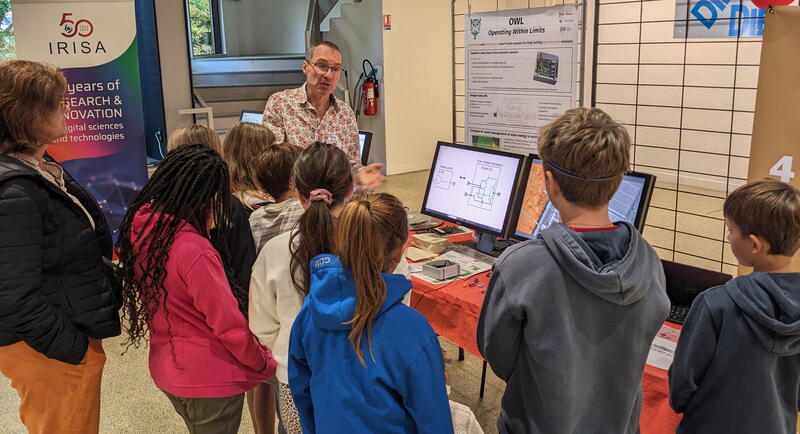
In Lannion, the TARAN and GRANIT research teams invited the general public along on the weekend of 3 and 4 October, and schoolchildren on Monday, to explore an object as unobtrusive as it is essential: the microchip.
What is a microchip used for? How is it designed? And how can it help us better understand our environment? These were just some of the questions the scientists answered through two complementary demonstrations.
Understanding how a microchip works
To begin with, visitors learnt about the principles behind the design and operation of microchips. Using a microscope, they were able to observe the structure of a microchip. They were then shown, through the concept of programmable logic and the role of transistors and logic gates, how a microchip can perform various operations.
This popular science presentation provided an insight into some of the work carried out by the TARAN team, which develops and optimises microchips using computer software.
Smart sensors for monitoring our environment
In the second part, our scientists demonstrated how a microchip connected to sensors can be used. It was precisely in this second part of the demonstration that the work of the GRANIT research team was explained: the optimisation of the processing carried out on these communicating sensor nodes.
An initial demonstration showed them that a sensor submerged in water, combined with a microchip, is capable, with simple processing, of measuring the pH level in the water and detecting the presence of lemon.
The focus then shifted to the ANR OWL project, dedicated to frugal embedded artificial intelligence. This application enables the detection of birds in their environment and the identification and classification of their songs. The sensors in this application are powered by ambient energy (solar, thermal, wind, etc.) and are therefore energy-autonomous. This enables bioacoustic observation and monitoring missions to be carried out whilst minimising the need for regular human intervention, with the aim of reducing environmental impact.
In Vannes
In Vannes, the Science Festival provided an opportunity to highlight the diversity of research in computer science, through projects combining artificial intelligence, environmental monitoring and artistic creation.
Artificial intelligence for Earth observation
In Vannes, the focus was on how advances in artificial intelligence and data processing can help us better observe and understand our environment, through the presentation of two European projects: DeepForMaP (Deep Learning for Forest Mapping using Point Clouds), dedicated to mapping forests using point clouds, and the AXOLOTL project (From sky to seafloor observation: Achieving eXcellence in Oceanic surveiLlance and cOnservation Through deep Learning), dedicated to monitoring maritime traffic to protect marine biodiversity
"From One Movement to the Next"
Another highlight in Vannes: the presentation of an immersive installation, "D'un mouvement à l'autre", conceived by Caroline Larboulette, a lecturer and researcher at the University of South Brittany and a member of the EXPRESSION team, and Laura Poupeville, a visual artist.
“From One Movement to the Next” is an installation made of fabric, metal, glass and virtual reality, exploring the permeability between the body and its environment and the influence of our physical environment on our gestures and movements throughout our lives.
Project supported by the PEPR programme
Bringing science to the public
In Rennes, Lannion and Vannes, these initiatives illustrate the richness of research carried out in computer science and the importance of sharing it with as many people as possible.
Thanks to the commitment of scientists, lecturers and researchers, students and our trustees, the Fête de la Science offers everyone the opportunity to discover, experiment with and gain a better understanding of the sciences that shape