
IRISA continues to celebrate its 50-year history...
September and October were dedicated to scientific outreach activities, open to all, highlighting half a century of knowledge in computer science research.
A look back at:
-
The conférence "50 ans d'intelligence artificielle, et après ?"
by Elisa Fromont, at the Espace des Sciences on 16 September -
The Science Festival in Lannion,
for schoolchildren and the general public, during the week of 6 October -
Science Festival at the INSA Rennes village
aimed at schoolchildren, Thursday 9 October -
"Les visites insolites" du CNRS,
a unique opportunity on 13 October to go behind the scenes of research -
JURASTIC's exhibition,
open from 9 October to 12 November, for young and old alike
The Conférence "50 ans d'intelligence artificielle, et après ?" by Elisa Fromont
On 16 September, the Espace des Sciences welcomed Élisa Fromont, Professor at the University of Rennes and head of the Malt research team, for a fascinating lecture tracing the evolution of artificial intelligence.
Through the prism of IRISA's history, Élisa immersed the audience in 70 years of AI development, demonstrating that this technology did not emerge with the modern digital era, but rather at the end of the Second World War. Contrary to popular belief, AI is a true historical saga that has evolved over the decades. From its origins and tentative first steps to today's explosion of ‘generative’ AI, Élisa Fromont outlined the major stages of this revolution, while raising the key questions facing scientists today.
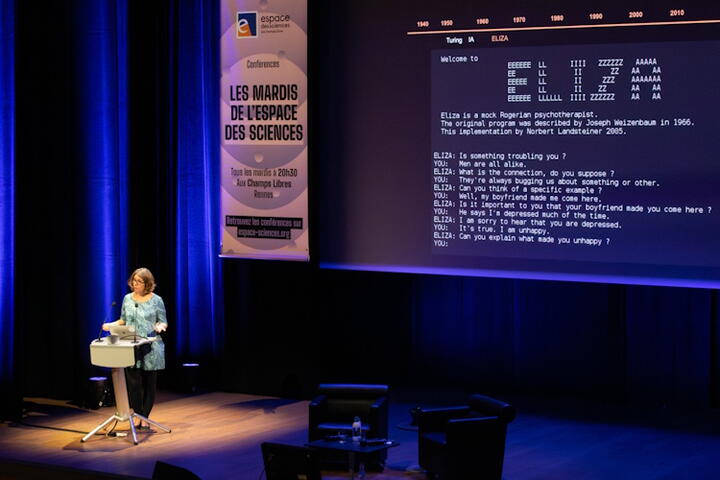
crédit photo / Julien Le Bonheur (Université de Rennes)
The Science Festival, in Lannion
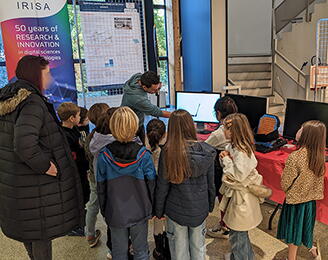
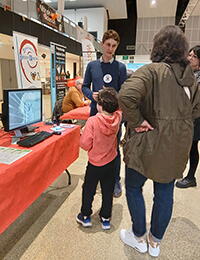
With the rise of artificial intelligence, we often hear about data centres. But did you know that it is also possible to make smaller electronic systems intelligent?
The Granit and Taran research teams at IRISA in Lannion presented how connected objects can revolutionise our daily lives in various fields such as health, sport, and many others.
|
Image
|
Image
|
The demonstrations were divided into three parts:
- How do microchips work? Viewing the inside of a chip under a microscope and explaining what a transistor is and how it makes the microchip intelligent.
- Indoor geolocation: Using new technology (UWB) built into certain phones to geolocate yourself inside buildings without using GPS.
- Connected paddle: An intelligent system that measures the movements of high-level kayakers to improve their performance.
Over the course of three days, 2,078 visitors attended the Science Festival at Les Ursulines in Lannion.
Science Festival at the INSA Rennes village
On Thursday, 9 October, INSA Rennes welcomed more than 1,000 pupils, from primary school to sixth form, for a day during which our scientists explained their research work in layman's terms.
Here is a brief overview of the various workshops led by our scientists
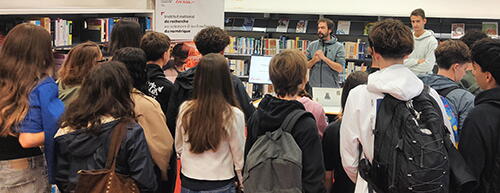
Let's play at creating images and videos with generative AI and understand how it works
[With Marc-Christie, Kelia Baert, Pierre Hellier, and Théo Gerard, members of the Virtus research team]
The pupils discovered what generative artificial intelligence is and how tools such as MidJourney and Stable Diffusion transform textual descriptions into images or videos. They explored the process of creating images from ‘noise’ (random pixels) and experimented with real-time video transformations.
- Watch the report on France 3 (in french)
|
Image
|
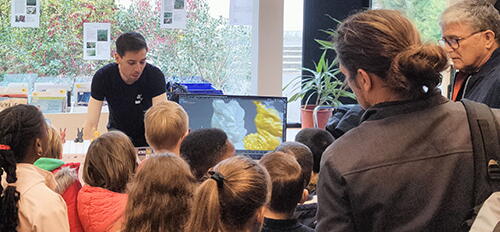
3D printing and accessible interfaces
[With Thomas Voisin, member of the Rainbow research team, among others]
Through 3D printing demonstrations, students explored how new technologies can help design technical aids for people with disabilities.
|
Image
|
Robotics and disability: mobility for all!
Rainbow Research Team - IH2A CHAIR
Team members presented assistive robotics solutions to improve the mobility of people with motor or cognitive impairments, offering a glimpse of the assistive technologies of tomorrow.
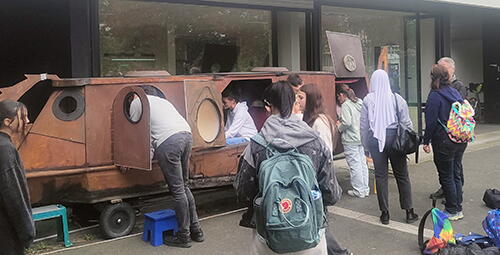
Virtual dive into the wreck of the Fetlar aboard the Nautilus submarine
[With Ronan Gaugne and Valérie Gouranton, members of the Seamless research team, and Marvin Johnson]
Thanks to this replica of the famous Nautilus submarine, students embarked on an immersive virtual exploration of the seabed and discovered the wreck of the Fetlar, a Scottish steam cargo ship that sank off the coast of Saint Malo in 1919...
|
Image
|
Conference: ‘Spies, Secrets and Codes: The Invisible War’
Gildas Avoine is a professor at INSA Rennes and a member of the Spicy research team.
During the Second World War, secret messages played a crucial role. But how could military information be protected from enemy ears? Thanks to cryptography, the art of encoding messages.
This presentation will immerse you in the fascinating history of wartime cryptography, from the Enigma machine to the work of Alan Turing, via the role of the Navajo Indians during the Second World War. This presentation will immerse you in the fascinating history of wartime cryptography, from the Enigma machine to the work of Alan Turing, including the role of the Navajo Indians during the Second World War.
Testing artificial intelligence through chess: Parrot (ChatGPT) vs fish (Stockfish): who wins?
Mathieu Acher, professor at INSA Rennes and member of the Diverse team, proposed an original chess game between two AIs, ChatGPT and Stockfish, to understand how artificial intelligence works and reflect on the notion of intelligence in machines.
Les visites insolites du CNRS
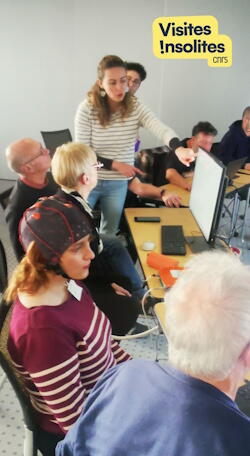
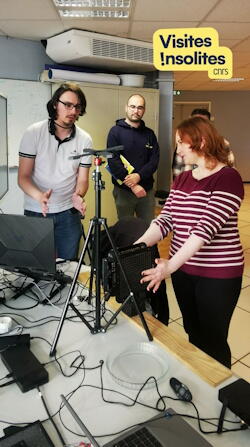
Touching the virtual: the fascinating interactions between humans and machines
Seventeen people, chosen at random, had the chance to go behind the scenes at one of the largest and oldest computer science research laboratories. During this visit, they took a fascinating dive into the world of human-machine interactions: how our brains can control digital applications... just through brain activity! But also how we can touch the future with our fingertips thanks to haptics, the science that allows us to feel and manipulate objects remotely or even in virtual reality!
|
Image
|
Image
|
JURASTIC EXHIBITION
JURASTIC takes you on a journey through the history of computing, from the 1970s to the present day. Featuring legendary computers and retro devices, the exhibition shows how advances in hardware have accompanied major advances in scientific research.
It will take place at Le Diapason on the Beaulieu campus from 9 October to 12 November 2025.
Come and discover these witnesses to a technological epic, deconstruct preconceived ideas about computing and gain a better understanding of IRISA's role in this scientific adventure!
Suitable for ages 13 and up, it is aimed at all curious minds, enthusiasts, retro-tech lovers and those eager for discovery.
Come and explore this unique and free exhibition (open to the public during Le Diapason's opening hours).
- Read the dedeicated article in Rennes Métropole (in french only)
More than 220 visitors and over 150 schoolchildren have already come to see the computer dinosaurs at the JURASTIC exhibition, from 9 to 11 October.