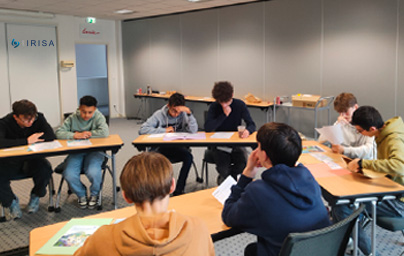
From 28 to 30 January, eight secondary school pupils came to discover the world of computer science research.
From Wednesday 28 January to Friday 30 January, together with the Inria centre at the University of Rennes, we welcomed eight secondary school pupils for a three-day work experience placement.
This year, the theme of the placement was ‘Digital technology and the environment’.
On the programme
-
Meeting with the research teams: OBELIX, CAPSULE, ÉPICURE, MAGELLAN, SEAMLESS , who presented their work on the theme of digital technology and the environment : Florent Guiotte, Sébastien Lefèvre, Aurore Guillevicn, Caroline Collange, Delphine Demange, Erven Rohou, Antoine Gicquel, Victorien Elvinger, Pablo Leboulanger, Matteo Chancerel, Ferran Argelaguet.
-
Participation in the SEnS conference on the ‘Environmental and societal impact of digital technology’, the aim of which was to take stock of the current situation with Benjamin Ninassi (Deputy Head of Inria's Digital and Environment Programme) and Françoise Berthoud (computer science research engineer at the CNRS and co-founder of the CNRS's EcoInfo group)
-
Review of the Jurastic exhibition and related themes: the ability to get old machines working again, reflection on the increasing capabilities and performance of current machines, etc. Our scientists (Caroline Collange, Delphine Demange, Erven Rohou, Antoine Gicquel) offered three workshops to trainees, which were very successful: retrogaming, light pen and computer-aided drawing
- A presentation on stereotypes in digital science professions by Elisa Denichou, mediator for the TiARE project
- Three games related to the theme or scientific mediation.
- A debate game on the theme of ‘digital technology and the environment’, led by Camille Sicot.
- PhoneImpact - - SmolPhone, a workshop to raise awareness of the environmental and social impacts of smartphone manufacturing and introduce the SmolPhone research project, which aims to explore the design of a low-tech phone. The workshop was mainly based on PhoneImpact, a serious game co-designed by educational engineers from Inria Learning Lab and two scientific experts from Inria. This board game puts participants in the shoes of a smartphone manufacturer and confronts them with the environmental and social impacts of their business, particularly those related to extractive activities. The workshop was led by Victorien Elvinger, Pablo Leboulanger, and Matteo Chancerel.
-
‘My thesis, what a story! - the game’, hosted by Thomas Maugey and Claire Cury, which highlights the doctoral journey while drawing on popularised texts written by doctoral students from the centre's project teams who participated in the dedicated training.
These three busy days concluded with a feedback session during which the young trainees presented their assessment of the course, which was extremely positive overall!
A big thank you to all our members who gave up some of their time and enthusiasm to share their profession and their research topics.