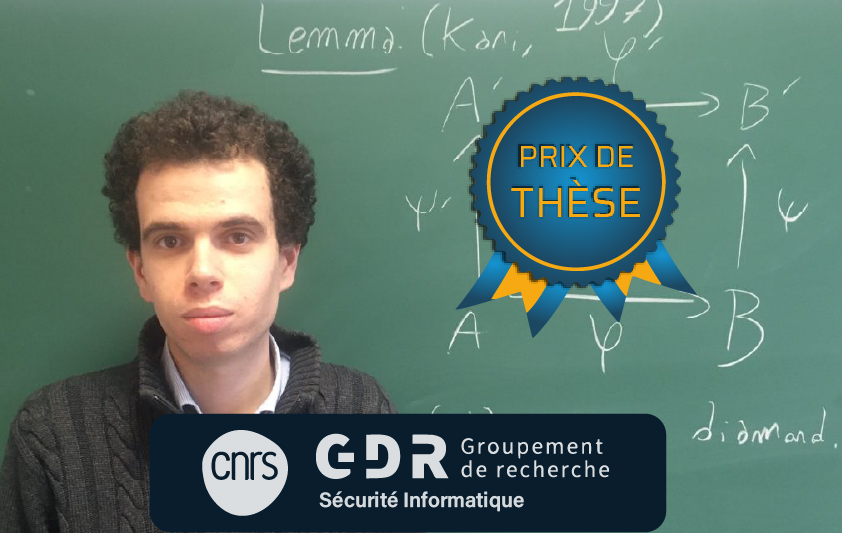
Congratulations to Pierrick Dartois, a member of the Capsule research team.
We congratulate Pierrick Dartois, recipient of the GDR Computer Security PhD Thesis Award, a national benchmark for academic research in cybersecurity in France, which annually recognizes outstanding doctoral work.
Pierrick Dartois completed his PhD thesis entitled «Fast computation of higher dimensional isogenies for cryptographic applications», at the l'Institut de mathématiques de Bordeaux, under the supervision of Damien Robert (University of Bordeaux) and Benjamin Wesolowski (ENS de Lyon), with co-supervision from Luca De Feo (IBM Research Zurich).
He is currently a postdoctoral researcher in the Capsule research team, where he continues his work on the mathematical foundations of post-quantum cryptography.
Attacks against SIKE have not compromised the future of isogenies; on the contrary, they have paved the way for new and more robust cryptographic constructions.. Pierrick Dartois
This distinction highlights the excellence of research conducted in the field of post-quantum cryptography and contributes to the visibility and impact of the work carried out within the Capsule research team.
To learn more...
With the growing threat of quantum computers to public key cryptography, quantum resistant cryptographic schemes have to be designed. Isogenies offer a way to propose such schemes which are more compact but unfortunately slower than their post-quantum competitors in the National Institute of Standards and Technology (NIST) standardization process. My PhD started right after the devastating attacks against SIKE, that did not harm the future of isogenies but led to the contrary. Indeed, these attacks have been used constructively to enhance or make possible several cryptographic constructions that did not suffer from SIKE's vulnerabilities. Among other constructive applications, my PhD used these new techniques to contribute to improvements of the digital signature scheme SQIsign, that greatly benefited from these enhancements in terms of performance and security analysis. I also worked on efficient algorithms to compute higher dimensional isogenies that made these constructions efficient.
You can learn more about my research on my webpage