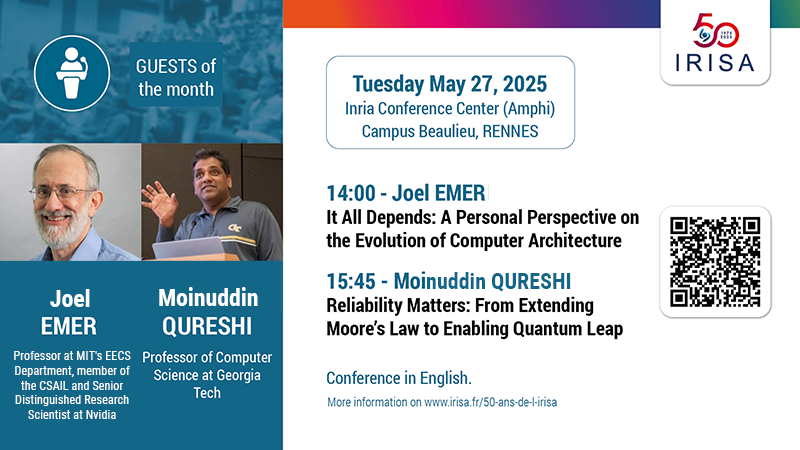
Introducing Joel Emer and Moinuddin Qureshi
by André Seznec, IRISA alumni
Program
These talks are open to a non-specialist audience interested in architecture (in English).
🕒 14:00 ⭢ 15:30 - Talk by Joel Emer
🥐 15:30 ⭢ 15:45 - Coffee break
🕒 15:45 ⭢ 17:15 - Talk by Moinuddin Qureshi
|
First talk - Joel S. Emer
14:00 ⭢ 15:30
It All Depends: A Personal Perspective on the Evolution of Computer Architecture
Over my nearly 50 year career in computer architecture research processor performance has improved by over three orders of magnitude. Those improvements have been premised on improvements at every level of a long-standing stack of abstractions. That stack is comprised of: (1) algorithms expressed in programming languages that are (2) converted by compilers into sequences of instructions that are (3) executed on computer architectures that are (4) implemented using transistors in the latest technology.
In this talk, I am going focus on the computer architecture level of the stack, where execution of instructions occurs. At that level, the intrinsic nature of instructions has remained relatively constant, but the techniques to execute them quickly have evolved significantly. At its heart, however, executing instructions is a step-by-step process where each step depends on information generated at prior steps. And therefore, dealing with those dependencies is what determines the performance of the architecture. So in the first part of this talk, I will frame a number of the techniques that have been employed to optimize performance as instances of a set of methods that can mitigate the impact of dependencies between (and within) instructions.
Although the abstraction stack and nature of instructions has remained remarkably constant over more than the last 50 years, that is now likely to change. That is due to the end of long-term technology scaling trends (usually
referred to as Moore's Law and Denard scaling) that is limiting the ability to keep making improvements without changing stack or at least the interfaces between levels. So in the second part of the talk, I will discuss my
philosophical perspective on the important attributes of the existing stack and provide some thoughts on how to both preserve those attributes and improve performance.
Second talk - Moin Qureshi
15:45 ⭢ 17:15
Reliability Matters: From Extending Moore’s Law to Enabling Quantum Leap
The primary role of a computing system is to reliably perform the tasks it is assigned. Factors such as performance and power efficiency are meaningful only so long as the system can reliably execute the specified computations. As Moore's Law reaches its limits, devices are becoming less reliable and are experiencing new types of failures. Addressing these reliability challenges efficiently is crucial to scaling to smaller technology nodes. Moreover, reliability tends to be a significant hurdle for all emerging technologies, whether it's new memory technologies, DNA storage, or quantum computing. Successfully overcoming the reliability challenges also plays a crucial role in enabling the emerging technologies.
In this talk, I will share our recent work on DRAM reliability and quantum computing to show how efficiently addressing device failures can help us push the boundaries -- whether extending Moore's Law or enabling quantum computing.
Biographies
More about Joel Emer
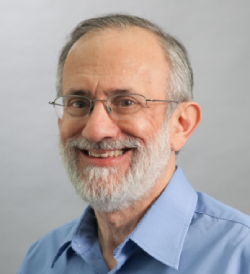 Joel S. Emer is a Professor of the Practice at MIT's Electrical Engineering and
Computer Science Department (EECS) and a member of the Computer Science and Artificial Intelligence Laboratory (CSAIL). He is also a Senior Distinguished Research Scientist at Nvidia in Westford, MA, where he is responsible for exploration of future architectures as well as modeling and analysis methodologies. Prior to joining Nvidia, he worked at Intel where he was an Intel Fellow and Director of Microarchitecture Research. Previously he worked at Compaq and Digital Equipment Corporation (DEC).
For nearly 50 years, Dr. Emer has held various research and advanced development positions investigating processor micro-architecture and developing performance modeling and evaluation techniques. He has made architectural contributions to a number of VAX, Alpha and X86 processors and is recognized as one of the developers of the widely employed quantitative approach to processor performance evaluation. He has also been recognized for his contributions in the advancement of deep learning accelerator design, spatial and parallel architectures, processor reliability analysis, memory dependence prediction, pipeline and cache organization, performance modeling methodologies and simultaneous multithreading. He earned a doctorate in electrical engineering from the University of Illinois in 1979. He received a bachelor's degree with highest honors in electrical engineering in 1974, and his master's degree in 1975 -- both from Purdue University. Among his honors, he is a Fellow of both the ACM and IEEE, and a member of the NAE. He also received both the Eckert-Mauchly award and the B. Ramakrishan Rau award for lifetime contributions in computer architecture.
More about Moinuddin Qureshi
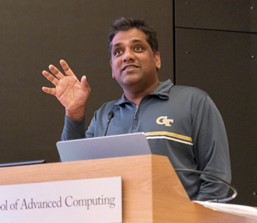 Moinuddin Qureshi is a Professor of Computer Science at Georgia Tech. His research interests include memory systems, hardware security, and quantum computing. Prior to Georgia Tech, he was a research scientist at IBM T. J. Watson (2007-2011), where he developed caching algorithms for Power-7. Qureshi received the 2022 ACM SIGARCH Maurice Wilkes Award for “contributions to high-performance memory systems” and is a fellow of ACM and IEEE. His research has been recognized with several best-paper awards, multiple inclusions at the ISCA-50 retrospective, and several "impact" awards, including the recent MICRO-2024 Test-of-Time Award. Qureshi is passionate about teaching and mentoring students. Several of his former PhD advisees are faculty members at top academic institutions. Qureshi received the 2024 "Outstanding Doctoral Thesis Advisor Award" at Georgia Tech.
This event is part of IRISA's 50th anniversary celebrations.
More details about the program on the dedicated page of our website.
