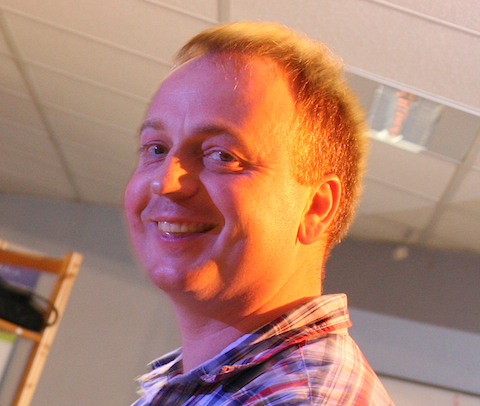
Alexandre Krupa

| Contact | Background and position | Research | Publications |

Contact


Email : Alexandre.Krupa@irisa.fr
Address : IRISA / INRIA Rennes
Campus Universitaire de Beaulieu
35042 Rennes cedex - France
Tel : +33 2 99 84 25 85
Fax : +33 2 99 84 71 71
Assistant : +33 2 99 84 22 52 (Céline Ammoniaux)

photo

Background and Position

I received the M.S. degree in control systems and signal processing from the National Polytechnic Institute of Lorraine (Nancy, France) in 1999. After preparing a PhD thesis in the eAVR team (équipe de Recherche en Automatique, Vision et Robotique) at the LSIIT laboratory (Laboratoire des Sciences de l'Image de l'Informatique et de la Télédétection, UMR CNRS/ULP 7005) in Strasbourg, I received my PhD degree in control systems and signal processing on 2003. From 2002 to 2004, I was assistant associate professor for undergraduate student lectures in electronics, control and computer programming at Louis Pasteur University in Strasbourg, France. Since September 2004, I am an INRIA research scientist at the French National Institute for Research in Computer Science and Control (INRIA) in the Lagadic research group at IRISA-INRIA Rennes. In 2006, I spent a sabbatical of 9 months in The Johns Hopkins University as a post-doctoral associate in the Computer-Integrated Surgical Systems and Technology Engineering Research Center (ERC SISST).

Research areas

My research interests include medical robotics, computer-assisted systems in the medical and surgical fields and most specifically the control of medical robots by visual servoing and force control.

PhD research works

The aim of my PhD research works was to extend the potential of teleoperated robotic laparoscopic systems by providing "automatic modes" by visual servoing using endoscopic images.

I designed a robotic visual servoing control system in order to assist the surgeon during a surgical laparoscopic intervention. This system allows to automatically retreive a surgical instrument which has been lost from the laparoscope field of view, and position it at a desired distance from an organ's surface point indicated by the surgeon directly in the endoscopic image. In my approach a specific instrument holder has been designed to project laser dots onto the surface of an organ in order to localize the instrument with respect to the scene.

In laparoscopic surgery, instrument motions are reduced to 4 degrees of freedom. In order to cope with this kinematic constraint, I designed a control system that uses online force measurement to guide a surgical laparoscopic instrument with a 6 degrees of freedom robot. A combined vision/force control scheme was also developed to actuate a laparoscope, held by the robot's arm, in order to track a moving surgical instrument.

Current research works

Since my position as an INRIA research scientist, I focus my research thematic on the development of new visual servoing methods using ultrasound images.

In a first work, I proposed a new visual servoing technique based on ultrasound images to automatically calibrate a robotic system used to perform 3D ultrasound imaging. The calibration procedure requires to position, for many orientations and positions, an ultrasound probe held by a medical robot in such a manner to bring the image plane on a fixed 3D point (intersection point of a cross-wire phantom build from two converging nylon yarns immersed in water). This was performed automatically by a visual servoing technique which consists in centering on an image target point the two image points corresponding to the intersections between the nylon yarns (2D straight line) and the ultrasound plane.

An important aspect of my research work is the study of new ultrasound image-based visual servoing techniques by modeling adequate ultrasound features and their interactions with the ultrasound probe motion. We proposed recently a method to automatically position an ultrasound probe in order to reach a desired view of an egg-shaped organ. I also work on the coupling of force control with ultrasound image-based visual servoing.

During my sabbatical in 2006, I started in collaboration with The Johns Hopkins University a new study based on the use of the speckle contained in ultrasound images to control a robotized ultrasound probe. The first application concerns the tracking of moving soft tissues. Experimental results demonstrated the feasibility of this innovative approach. I currently work to improve the method in order to allow its use in many medical applications, for example to automatically move the ultrasound probe to maintain an appropriate view of moving soft tissues during ultrasound scanning or to synchronize the insertion of a needle into a moving target during biopsy or local therapy.

PhD student

Rafik Mebarki

Demonstrations

Here are some links with videos on my research works:


This video (23 Mo divx avi file) shows the autonomous retrieval and 3D positioning of a robotized laparoscopic instrument by visual servoing using endoscopic images (my PhD work in eAVR, LSIIT laboratory)


Link to the robotized 3D ultrasound imaging demonstration

Publications

Complete list (with postscript or pdf files if available)

| Lagadic | Map | Team | Publications | Demonstrations |
Irisa - Inria - Copyright 2009 © Lagadic Project